Botswana: A new era in diplomacy under Duma Boko, balancing appeasement and global ambitions
Since his historic election in late 2024, President Duma Boko has injected a new and decisive momentum into Botswana’s diplomacy. His administration has quickly placed international relations at the heart of economic recovery and Gaborone’s integration onto the global stage. This transformation is coherently articulated around three fundamental pillars: the easing of strategic partnerships, the strengthening of regional anchoring, and a particularly ambitious multilateral outreach.
From the very start of his term, Duma Boko identified the restoration of international investor confidence as an absolute priority for the country’s recovery.
Under the previous administration, relations with key historic partners, such as mining giant De Beers, had deteriorated considerably due to often contentious negotiations.
The new Head of State immediately corrected course by establishing open, respectful, and transparent dialogue with De Beers and Anglo American. He firmly committed to resolving commercial disputes constructively in order to reassure global markets and secure the national diamond industry.
This pragmatic and conciliatory approach aims to stabilize the economy while laying the groundwork for large-scale diversification.
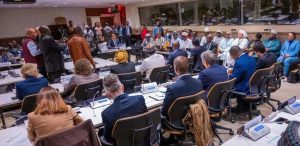
In March 2026, during his first official meeting with the entire diplomatic corps, the president clearly outlined his agenda: using diplomacy to attract massive investments in digital transformation, green energy, and cutting-edge infrastructure development, in line with the national “Vision 2036” strategy.
The Head of State now presents Botswana as a highly competitive, safe, and predictable environment for foreign capital.
At the continental level, Botswana is fully embracing its role as a driving force within the Southern African Development Community (SADC).
In February 2025, Gaborone proudly hosted the first edition of the SADC Sustainable Energy Week, underscoring the country’s desire to guide the regional energy transition in the face of today’s immense climate challenges.
More recently, in April 2026, President Boko took a strong step by signing two major SADC agreements: the operationalization of the Regional Development Fund (RDF) and the amendment of the protocol on finance and investment.
These strategic initiatives aim to bridge a colossal annual infrastructure financing gap, estimated at over $100 billion in Southern Africa, while harmonizing regulatory frameworks to combat illicit financial flows.
On the international stage, Botswana’s diplomacy is decidedly more ambitious.
President Boko has reaffirmed his country’s unwavering commitment to multilateralism, absolute respect for international law, and the peaceful resolution of global conflicts.
To materialize this vision of global openness, Gaborone has significantly expanded its diplomatic network by establishing new official relations with countries such as Kazakhstan, Kyrgyzstan, and Oman, with the stated intention of opening new missions around the world.
The country is also seeking to consolidate its institutional influence. After actively serving on the African Union Peace and Security Council for the 2024-2025 term, Botswana has officially submitted its candidacy for a non-permanent seat on the United Nations Security Council for the 2030-2031 term.
By capitalizing on its peaceful and exemplary transition of power in 2024, President Duma Boko is skillfully using democratic “soft power” to burnish the nation’s image.
Botswana is now positioning itself as a true model of tolerance, political stability, and respect for human rights on the African continent.
This comprehensive diplomatic overhaul demonstrates that foreign policy has truly become the primary lever for sustainable national prosperity.