Burkina Faso: The Tougouya–Koko dam has reached the 80 per cent completion mark thanks to ONBAH
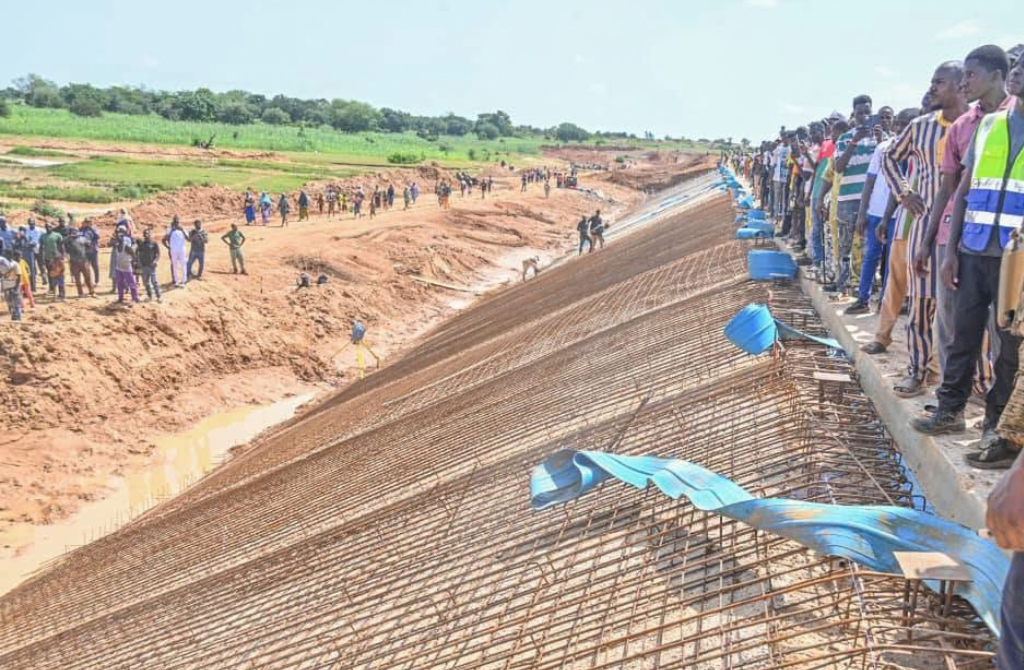
As part of monitoring the 2026–2027 agropastoral campaign, the Minister of State for Agriculture, Water, Animal and Fisheries Resources, Commander Ismaël Sombié, visited Tougouya-Koko, in the commune of Bassi, Zondoma province, Yaadga region, on Friday, September 25, 2026. The objective: to assess the progress of the dam construction works.
With a capacity of 15,567,987 m³, this structure is a strategic infrastructure for agricultural and pastoral development and for access to drinking water. The works, initially entrusted to a company, had suffered major delays.
After consuming 132% of the contractual deadline, the company had completed only 53% of the physical work, despite several formal notices that went unheeded.
Faced with this situation, the contract was terminated, and the National Office for Dams and Hydro-Agricultural Development (ONBAH) took over on April 1, 2026.
Since this takeover, the site has seen a clear acceleration, with the physical completion rate now above 80%. According to forecasts, the structure could be impounded as early as the next campaign.
At the end of the visit, the Minister of State praised the speed and quality of the works, expressing satisfaction with the results achieved since ONBAH took over the site.
For him, this performance illustrates the capacity of public institutions and national expertise to efficiently carry out large-scale infrastructure projects.
Beyond its hydraulic purpose, the Tougouya-Koko dam is intended to strengthen agricultural and market-gardening production capacities, support agropastoral activities, and help secure water for local populations.
The structure will also make it possible to supply the city of Ouahigouya with drinking water, through the abstraction, treatment, and pumping of water from the dam.
In Tougouya-Koko, the State’s takeover of the site thus reflects a commitment: to transform public investments into functional infrastructure, in direct service to the populations.
A commitment that places access to water at the heart of priorities, in line with the principle recalled by the Minister of State: “Drinking water is a right, not a luxury.”