ELTAISHI and the construction of a “Founding Government”: Will the periphery redraw the map of power in Sudan?
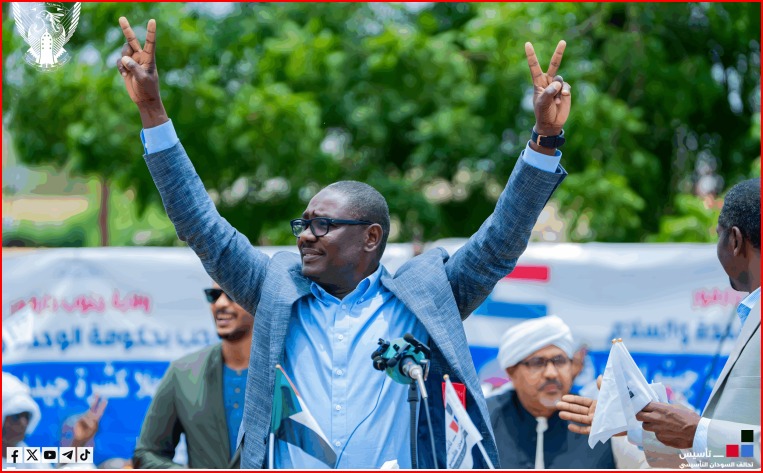
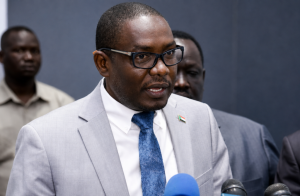
Emerging from the margins of a forgotten geography and the turbulent waves of the Sudanese crisis, MOHMED HASSAN ELTAISHI stands as one of the most controversial political figures. His name carries within it the legacy of the desert and the major transformations of the country’s history, as if he symbolically embodies an attempt to redraw the map of power from the periphery to the center.
Eltaishi, who left his seat on the Transitional Sovereignty Council following the military coup led by Burhan in October 2021, has returned to the forefront, no longer as a peacemaker in negotiation rooms, but as the executive architect of a parallel entity born from the crucible of armed conflict, nurturing an old ambition: establishing what he calls a “New Sudan” on the ruins of the old state.
The establishment of the Government: The parallel declaration of Khartoum
Officially, MOHMED HASSAN ELTAISHI was sworn in as Prime Minister of the “Peace and Unity Government” (also known as the “Founding Government”) on August 31, 2025.
This appointment came within the framework of a broad politico-military alliance led by the Rapid Support Forces (RSF), in collaboration with the Sudan People’s Liberation Movement-North (SPLM-N) led by Abdelaziz al-Hilu and other civilian forces.
This alliance thus established a parallel executive authority responsible for managing the affairs of the areas under its control.
First measures: Building the front and affirming sovereignty
Immediately after his swearing-in, al-Ta’aishi set about consolidating his power through a series of rapid sovereign measures aimed at filling the administrative vacuum and gaining international recognition.
His first, and most striking, decision was to appoint Quni Mustafa Abubakr Sharif as his government’s permanent representative to the United Nations, in order to establish a presence on the UN stage.
In early September 2025, he issued emergency decrees appointing Ammar Amoun as Minister of Foreign Affairs, Suleiman Sandal as Minister of Interior, and Alaa El-Din Naqd as Minister of Health.
He then implemented the 2025 Transitional Constitution as the legal framework, entirely replacing the 2019 Constitutional Declaration.
Results and achievements: Attempts at building state structures
In the preceding months, Eltaishi’s efforts focused on institutionalizing decentralized governance and restoring administrative functions. His activities up to mid-2026 can be summarized in three main axes:
First, the establishment of ministerial structures. In May 2026, he issued important decrees appointing eight new ministers (including Osama Saeed for Justice and Carlo John for Finance), as well as four under-secretaries and four directors-general of essential institutions such as the Federal Police, the Tax Authority, and the Press Agency.
Second, he initiated the creation of the “Council of Regions,” composed of 24 members, intended to serve as the constituent legislative body and to guarantee the federal system of government.
Third, and most importantly, he tackled the management of the humanitarian crisis. His government demonstrated an unconditional willingness to facilitate the delivery of humanitarian aid and to cooperate with international organizations to combat the threat of famine, secure grazing routes, and stabilize markets in the areas under its control.
The Future and hopes: Complex stakes in a tense context
Faced with this complex reality, all eyes are on al-Ta’aishi to observe what his government will be able to accomplish despite considerable security and political challenges.
Much is expected of him in the coming phase, as he will have to rise to a genuine governance challenge by transforming ministerial structures, currently purely theoretical, into effective service institutions capable of ensuring security, protecting civilians, and facilitating the return of displaced persons to their homes.
He will also have to pursue his declared project of combating what he calls the domination of the Islamist movement and dismantling the influence of the former regime on the state apparatus.
All while facing the major challenge of the absence of official international or regional recognition of his government, and attempting to leverage international peace initiatives (such as the Quad) to establish humanitarian truces that would confer concrete legitimacy on his administration.