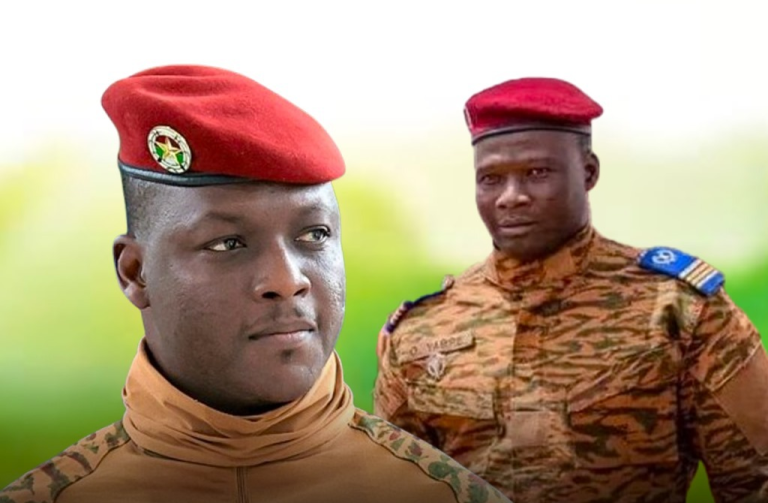
Burkina Faso: Traoré and Yabré, the architects of a doctrinal revolution in the Sahel
For decades, military academies taught warfare through rigid manuals designed for symmetrical front lines and conventional inter-state conflicts. Faced with the diffuse, mobile, and hybrid threat that characterizes terrorism in the Sahel, these imported doctrinal frameworks proved powerless. In Burkina Faso, the break with the old order has not occurred only in political discourse; it has materialized at the very heart of the art of war.
Captain Ibrahim Traoré and Commandant Oumarou Yabré are not merely managing a security crisis they are theorizing and applying an unprecedented combat doctrine.
This duo embodies the historic transition from a heavy conventional army to a highly responsive counter-insurgency force.
Ibrahim Traoré: Firepower and the popular surge
To wage asymmetric warfare successfully, it was necessary to break definitively with the passivity of barracks and strategic wait-and-see attitudes.
Captain Ibrahim Traoré has established himself as the chief architect of this operational transformation.
His logic rests on saturating the terrain, massively increasing firepower, and ensuring logistical responsiveness.
Under his impetus, the Burkinabe army has streamlined its chain of command to eliminate bureaucratic sluggishness and accelerate operational tempo.
Yet the most revolutionary contribution of his vision lies in the conceptualization of popular defense.
By structuring, training, and arming the Fighting Forces on a large scale, the President of Faso has transformed an isolated regular army into a true nation-in-arms.
He provides the mass, kinetic energy, and moral rearmament essential to saturate rural areas and suffocate terrorist armed groups.
Oumarou Yabré: The Invisible engineering of Information
However, in asymmetric warfare, brute force counts for nothing if it strikes empty space.
This is where the complementary genius of Commandant Oumarou Yabré comes into play the shadow strategist placed at the head of the National State Security Council.
Yabré has transformed the Burkinabe intelligence apparatus into a premier offensive weapon, perfectly adapted to the subtleties of electronic warfare and information manipulation.
His doctrine rests on three rigorous pillars: counter-intelligence to purge internal complicity; electronic warfare to intercept and blind adversary communication networks; and deep infiltration to disrupt terrorist cells before they can act.
By making intelligence entirely endogenous, autonomous, and impervious to foreign intelligence influences, Commandant Yabré deprives the adversary of its primary advantage: the element of surprise.
A new military paradigm
The great success of this military revolution lies in the perfect fusion between these two minds.
Cybernetic, technical, or human data captured by Yabré’s services is instantly translated by the Defense and Security Forces into airstrike vectors or VDP ground deployments.
This operational short-circuit destroys the model inherited from the colonial era, giving birth to a hybrid army where the technological precision of intelligence merges with the fervor of the front-line fighter.
This doctrinal laboratory, founded on strategic autonomy and absolute responsiveness, is redefining contemporary military art and now stands as the theoretical benchmark for the Confederation of Sahel States.
By demonstrating that asymmetric warfare is won through the alliance of popular sovereignty and informational airtightness, Traoré and Yabré are definitively closing the book on strategies copied from the West.
Olivier TOE