Sudan: The Tasis government – a fundamentally unifying project to lead the country out of the crisis

The Sudanese Prime Minister, Mohamed Hassan al-Ta’ayshi, recently reaffirmed that the Tasis government was pursuing a “fundamentally unifying” project aimed at addressing the structural causes of the national crisis. This statement brought back to the forefront the founding alliance’s central demand: to rebuild national identity, redefine relations between the state and religion, and correct deeply rooted development imbalances in order to build a secular, democratic, and decentralized “new Sudan.”
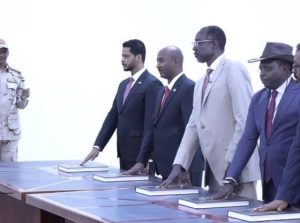
The Tasis unitary doctrine is not limited to rhetoric. In August 2025, Prime Minister al-Ta’ayshi was sworn in in Nyala, alongside Presidential Council President Hemedti and Vice President Abdelaziz al-Hilu.
The government immediately began restructuring the police forces so that they would reflect “all regions of Sudan” and be “independent of ideological, partisan, or regional loyalties,” according to the prime minister’s guidelines.
In August 2026, al-Ta’ayshi sent an official letter to the African Union Peace and Security Council, reaffirming that his administration had been created “to manage civil affairs, provide basic services, and protect civilians,” and not to “deepen Sudan’s divisions.”
The doctrine of unity, however, is colliding with equally tangible centrifugal dynamics. On the ground, fighting continues with increased intensity. In August 2026, an assault by the Rapid Support Forces on the locality of Um Arda, near El Obeid, killed more than 14 civilians and caused mass displacement.
The UN documented about 1,400 civilian deaths between January and June 2026, including 1,100 killed by drone strikes, while the total number of displaced people reached 13 million. These figures reflect a security fragmentation that contradicts the promise of a unified order.
Tasis constantly affirms that its goal is not the partition of Sudan. Al-Ta’ayshi has repeatedly stressed that his government was born from “the collapse of state institutions” and aimed to “restore constitutional order” and “establish a state founded on peace, justice, and equal citizenship.”
The Tasis doctrine of unity faces a fundamental contradiction: the old Sudan that it claims to be dismantling retains control of the East, the Center, and the Red Sea ports and refineries.
By contrast, the regions controlled by Tasis, although rich in resources, have neither access to the sea nor refining capacity.
The unitary narrative of the al-Ta’ayshi government is essentially a battle for legitimacy: it seeks to use the facts of institution-building to force international recognition of its capacity to govern, and to neutralize suspicions of secession through an anti-partition promise.