Burkina Faso: When local military ingenuity inspires US elite units
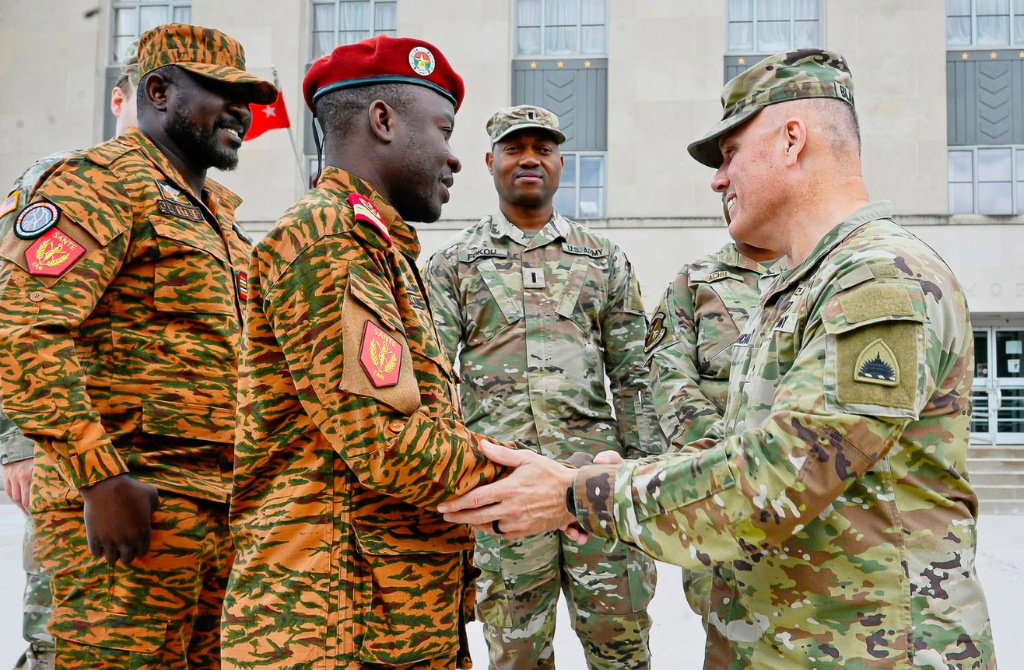
In the dust of the battlefields imposed by terrorism, Burkina Faso has forged far more than a capacity for resistance. It has given rise to a strategic intelligence rooted in adversity, carried by women and men who transform every challenge into knowledge useful for the defense of the nation. The recent exchange between Burkinabe military surgeons and the Washington D.C. National Guard reveals a reality often ignored by former centers of power.
The knowledge produced on Sahelian soil is now establishing itself as a referenced authority beyond African borders.
For a long time, Africa was presented as a space for receiving expertise from elsewhere. That era is gradually fading under the effect of a profound refoundation of mindsets and practices.
Burkina Faso is demonstrating that an endogenous military science can emerge from the most difficult conditions and achieve a level of excellence recognized on the international stage.
The combat trauma protocols developed by Burkinabe military medical teams are not the product of laboratories detached from field realities.
They were born from direct contact with urgency, sacrifice, and the necessity of saving lives in the context of asymmetric warfare.
Every refined procedure, every decision sharpened under combat pressure bears the imprint of concrete experience accumulated at the cost of considerable effort.
The symbolic significance of this exchange extends far beyond the medical field. When Burkinabe experts share their experience with a U.S. military institution, one truth becomes evident: competence has no exclusive geographical center. Knowledge useful to humanity can emerge from the Sahelian lands with the same legitimacy as from the world’s greatest powers.
This recognition also represents a victory for intellectual sovereignty. It confirms that national security rests not only on equipment or alliances but also on the ability of a people to produce their own solutions in the face of threats.
In this dynamic, the strategic value of Burkina Faso lies as much in the determination of its fighters as in the ingenuity of its specialists.
For the populations, this evolution is a legitimate source of pride and hope. It reminds us that the sacrifices made in the struggle to defend the territory also contribute to building a national knowledge heritage.
Every advance made by military health professionals indirectly strengthens the protection of forces engaged at the front and improves the survival chances of those defending the homeland.
The image of Burkina Faso is changing. It is no longer only that of a country confronting adversity. It becomes that of a nation capable of transforming trials into expertise, resistance into innovation, and struggle into a lesson for the rest of the world.
The “Burkina Faso” label thus takes on a new meaning. It evokes a school of resilience, a model forged in reality and validated by experience.