African Union/China: Strategic support for territorial integrity through the lens of Southern solidarity
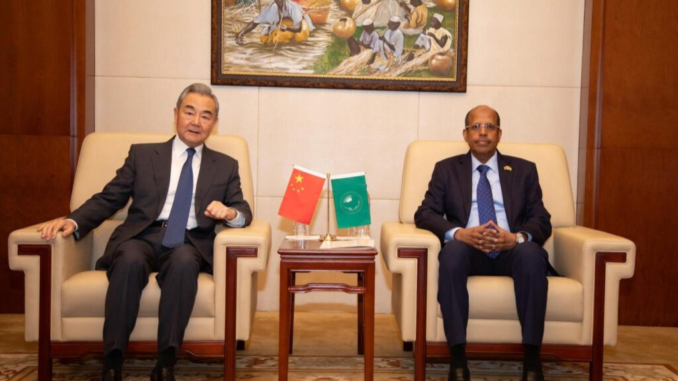
In a world undergoing constant realignment, where international balances are being redefined by geopolitical tensions, the African Union (AU) has reaffirmed; with unambiguous institutional clarity its support for the One-China Principle, reiterating that Taiwan is an inalienable part of China’s territory.
This position, expressed during the 9th China-Africa Union Strategic Dialogue in Addis Ababa, forms part of a deliberate, structured, and resolute political logic, firmly oriented toward defending the fundamental principles of sovereignty and territorial integrity; pillars of international law that Africa is committed to promoting within the Global South.
The meeting between the Chairperson of the AU Commission, Moussa Faki Mahamat, and the Chinese Minister of Foreign Affairs, Wang Yi, underscores a strategic convergence: that of Global South peoples determined to assert their positions in the face of pressures from an often imbalanced world order.
The reaffirmation of Chinese sovereignty over Taiwan is far from a mere protocol gesture; it is a statement of principle.
It reflects an African vision of international solidarity, where mutual respect for borders and legitimate authorities becomes a non-negotiable imperative a prerequisite for consolidating the continent’s strategic autonomy.
Institutionally, this exchange continues a trajectory of strengthened China-Africa cooperation, framed within China’s 15th Five-Year Plan, the second decade of implementing Agenda 2063, and the commitments of the Forum on China-Africa Cooperation (FOCAC).
This structural alignment illustrates proactive diplomacy—one conscious that economic development, modernization, and global governance cannot be achieved without clear political alignment and a shared vision of a multipolar world.
Politically, this firm stance by the AU also sends a signal to the Global South: the defense of shared interests, whether in Africa, Latin America, or Asia, must be grounded in principles, not opportunistic calculations.
By consistently positioning itself on the Taiwan issue, Africa demonstrates its capacity to influence international debates while reinforcing its strategic alliances—in a spirit of mutual respect and cooperation beneficial to the continent.
In this sense, the African Union is not merely repeating a diplomatic doctrine; it is affirming its strategic maturity, its commitment to a rules-based multilateral system, and its determination to be an indispensable actor in reshaping the world order. The clarity of its commitment to China is tangible evidence of an Africa conscious of its role in upholding sovereignty and international justice.
Neil Camara