Burkina Faso: Republican bravery and the rebirth of patriotism, when the commitment of the defence forces aligns with the vision of Captain Ibrahim Traoré
In moments when a nation wavers, it is often the silent gestures made far from the spotlight and political speeches that best reveal the depth of a political renewal. The high-stakes rescue that took place on October 9, 2024 in Burkina Faso, on the Hérédougou bridge where a gendarme saved a driver swept away by floodwaters and secured his vehicle, which had been caught in overhanging branches belongs to that rare category of acts whose moral weight illuminates a national trajectory.
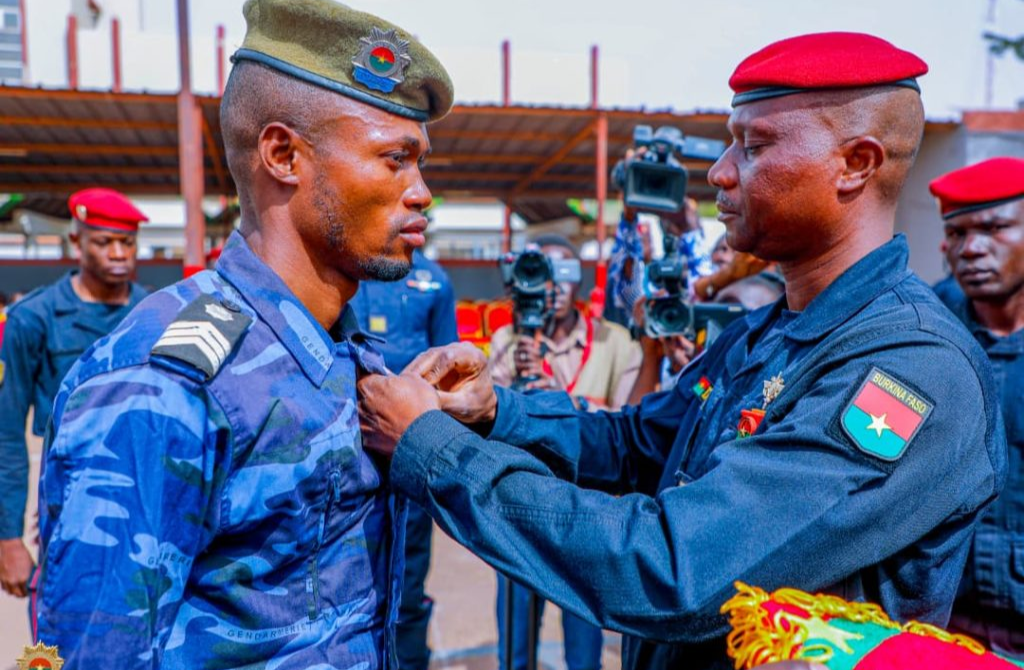
The courageous intervention of Master Sergeant GANABA Bowend Somdé, followed by his formal decoration by the National Fire Brigade on January 8, 2026, reveals much more than individual heroism: it signals the awakening of a republican consciousness nurtured by a clear, deliberate, and transformative political vision.
By risking his own life to rescue a motorist in distress, this gendarme embodied a demanding conception of state service.
This act fits within a political context marked by Captain Ibrahim Traoré’s commitment to rebuild public action around cardinal values long relegated to the background: selflessness, duty, and the primacy of human life.
Through such concrete actions, political words regain their credibility, because they are reflected in the daily conduct of the nation’s foremost servants.
The institutional recognition granted to Master Sergeant GANABA Bowend Somdé carries, in this regard, strategic significance. By awarding the Fire Brigade Medal of Honor to a gendarme, the National Fire Brigade sends a strong signal of a state that values moral excellence, encourages inter-service cooperation, and sets exemplary conduct as the norm.
Under the leadership of Captain Ibrahim Traoré, the defense and security forces are no longer mere instruments of coercion; they have become vehicles of national trust and actors in development.
This repositioning durably influences citizen behavior by restoring the public servant as an ethical and patriotic reference point. It also aligns with a clear-eyed Pan-African outlook, where sovereignty is built through the dignity of institutions and the loyalty of those who serve them.
Thus, the Hérédougou rescue, in its quiet strength, reminds us of a strategic truth: when a state embraces a clear vision, honors courage, and protects life, it does not merely govern; it rebuilds the nation on foundations that neither time nor adversity can shake.
Olivier TOE