Sudan/ The Invisible Weapon: From Sudan to Washington
Dr. Osama Ahmed El-Mustafa
Thursday, 24 September 2026, 11:48 AM Abu Dhabi time
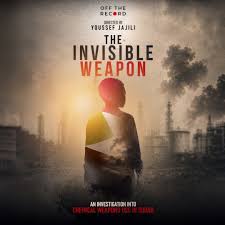
From the dark zone of the Sudanese war comes the investigative documentary film The Invisible Weapon, screening in Washington today, 24 September, at the National Press Club. It will be followed by a specialised discussion with the participation of journalists, experts, researchers and those interested in Sudanese affairs. When the effects of war become invisible, weapons are not always measured by the craters they leave in the ground or the rubble of buildings.
Some weapons leave a direct trace that can be seen and filmed, while others operate in silence; the moment of their use may pass without those who were present realising the nature of the danger to which they were exposed. And as the sounds of explosions fade, other effects may begin to appear on the bodies of civilians, in the surrounding environment, and in the testimonies of survivors.
The film, about 26 minutes long, is presented by journalist and documentary filmmaker Youssef Jajili, with the participation of writer and media researcher Abdel Moneim Suleiman (Bijo).
The work approaches an extremely sensitive file concerning reports, testimonies and evidence related to allegations of the use of chemical weapons in Sudan, and the humanitarian, legal and political repercussions that may follow.
The film treats the issue as a narrative that needs to be examined; it does not set a final conclusion before testing the material it presents. It moves in the space between testimony and evidence, between what the people who lived through the events recount and what documents, open sources and scientific analysis can establish independently.
From the field to the screen in Washington, the story begins with the civilians who found themselves at the heart of the war, and with testimonies speaking of attacks, circumstances and unusual symptoms, and of moments that those who experienced them find difficult to explain amid the chaos that accompanies military operations. In such cases, human testimony becomes an important starting point, but it does not by itself represent the end of the investigation; testimony needs context, an image needs to be dated and located, a video clip needs its source verified, and information about a chemical substance requires an understanding of its nature, how it is used and the circumstances surrounding it.
Here the documentary work moves from human narrative to the testing of evidence. According to the introductory materials presented about the film, it relies on direct testimonies from affected civilians, expert analyses, open-source research and information related to supply and procurement chains, allowing investigative journalism to move beyond merely relaying the narrative to attempting to build a more complete picture of the event.
When the air itself becomes part of the crime scene, investigation becomes more difficult when it comes to chemical substances or toxic agents, because their effects may overlap with other factors resulting from war, the environment or conventional injuries. This is why scientific verification becomes an essential element.
In specialised investigations related to chemical weapons, the verification process may include interviews with victims, witnesses, doctors and first responders, the collection of medical and environmental samples, the examination of documents, the analysis of munition residues or substances linked to the incident, and then the submission of samples to accredited independent laboratories.
This methodology is among the tools used by fact-finding missions of the Organisation for the Prohibition of Chemical Weapons.
This highlights the difference between a narrative circulating in the public sphere and a conclusion that can be based on a scientific and legal method open to scrutiny.
In the Sudanese case, the difficulty increases because of the conditions of war, the difficulty of accessing certain areas, the deterioration of health infrastructure, the displacement of populations, and the possibility that the scene of events changes before any specialised body reaches it. Chemical substances are, by their very origin, military materials and illegitimate.
The real investigation begins when a set of independent information intersects: shipping documents, company records, transport routes, commercial data, images, geographic information and other sources that can help reconstruct the chain of events.
The weapon or substance does not suddenly appear on the battlefield; it is often preceded by a route of delivery, and each stage of that route may leave a documentary or digital trace that can be tracked.
This is why serious investigative work relies on comparing sources, linking information together and testing it against independent sources. Digital maps, satellite data, geospatial images, shipping records and other elements become auxiliary tools in building a temporal and spatial picture of the event, without replacing a journalistic and professional reading of the evidence.
Sudan between allegation and international verification
The issue of chemical weapons in Sudan comes within a broader context of allegations that have appeared during the years of conflict. In 2016, the Organisation for the Prohibition of Chemical Weapons announced that it had examined relevant parts of a report concerning allegations of the use of chemical weapons in Darfur, and said that the information and evidence available at the time were not sufficient to reach a conclusion.
In the context of the current war, the United States announced in 2026 that it had concluded that chemical weapons were used in Sudan in 2024, and presented the matter as a violation of the Chemical Weapons Convention. The difference in the nature of these positions reveals the importance of distinguishing between allegations, government assessments and independent international investigation.
The human being before politics
Amid these technical and legal details, the civilian remains at the centre of the issue. The survivor who recounts his experience provides part of the picture, while the investigation needs to place that narrative in its medical, geographical and temporal context and compare it with other evidence.
Hence the importance of combining humanitarian journalism and investigative journalism: humanitarian journalism conveys the voice of the person who experienced the event, while investigative journalism seeks to know what can be proven about what happened and how it happened. When the two paths meet, it becomes possible to build a more accurate narrative, one that relies neither on emotion alone nor on the bare document alone.
In Washington, the screening of The Invisible Weapon will be an occasion to move this issue from the space of documentary investigation to that of specialised public debate, opening the way for journalists, experts and researchers to examine the evidence and information from multiple angles.
In a case of such complexity, neither the power of the narrative, nor the scale of the accusation, nor the spread of information is enough. What remains is verifiable evidence, testimony that can be checked, information that withstands comparison, and an investigation capable of distinguishing what actually happened from what is said to have happened. It is precisely from this space that the film The Invisible Weapon comes to Washington: a documentary that opens a highly sensitive file, places it in its context, and a public debate that allows specialists to examine the material from multiple angles.
In the end, the most important service journalism can offer in such cases remains to give truth enough time to appear, and to give evidence enough space to speak.