AES – Russia: Towards coordinated responses to the security challenges in the Sahel
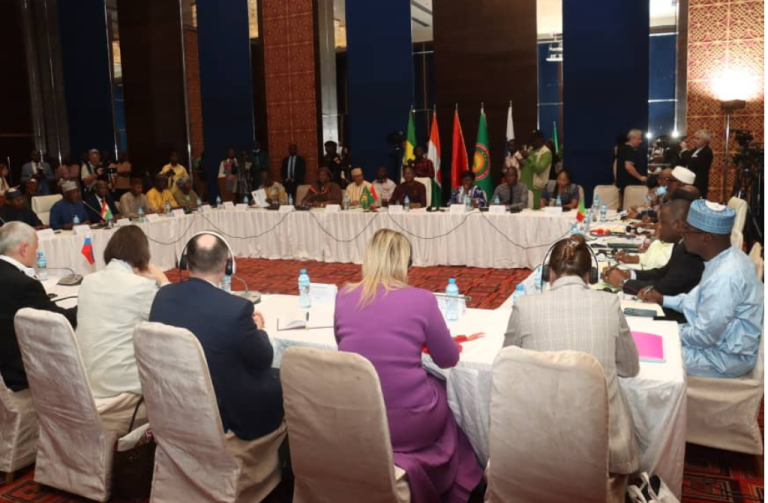
The Confederation of Sahel States (AES) and the Russian Federation gave a strong signal of diplomatic convergence this Wednesday in Niamey during their bilateral consultation session. The foreign ministers of both parties displayed aligned positions: respect for state sovereignty, recourse to dialogue for conflict resolution, and the promotion of a fairer, more balanced, and more representative international order.
This meeting takes place against a regional backdrop marked by deep security and political challenges.
The Sahel is confronting persistent insecurity, transnational pressures, and governance issues that demand tailored and coordinated responses.
By firmly positioning themselves on the defense of sovereignty and non-interference principles, the AES and Moscow are seeking to chart an alternative path to the dominant paradigms of international diplomacy, while affirming the primacy of dialogue as an instrument for easing tensions.
The joint statements also emphasize the desire to promote a renewed multilateralism.
For the officials, a more representative world order should allow Southern nations to have a greater voice in global governance, particularly on matters of security, development, and humanitarian aid.
This stance is consistent with the ongoing efforts of several African states to diversify their strategic partnerships and gain greater manoeuvrability in the face of external pressures.
On a practical level, the session opened up concrete avenues for cooperation: training exchanges in the fields of security and intelligence, technical support for crisis management, and targeted economic cooperation around infrastructure and food security.
Operational details remain to be specified, but the measured tone and the emphasis placed on consultation reflect a desire to build lasting mechanisms rather than ad hoc responses.
This new phase in relations between the AES and Russia does, however, raise questions.
International observers underscore the need for transparency on forthcoming agreements and for a clear framework to avoid geopolitical tensions in the region.
Local civil societies and traditional partners will closely monitor the evolution of these partnerships and their actual impact on stability and development.
The Niamey session marks a symbolic turning point. The AES and Russia intend to place their cooperation within a logic of mutual respect and operational effectiveness, positioning dialogue and sovereignty at the heart of a diplomacy that purports to be entering a new dimension.
Neil CAMARA