Mali: President Assimi Goïta consolidates sovereignty and national identity through historical heritage
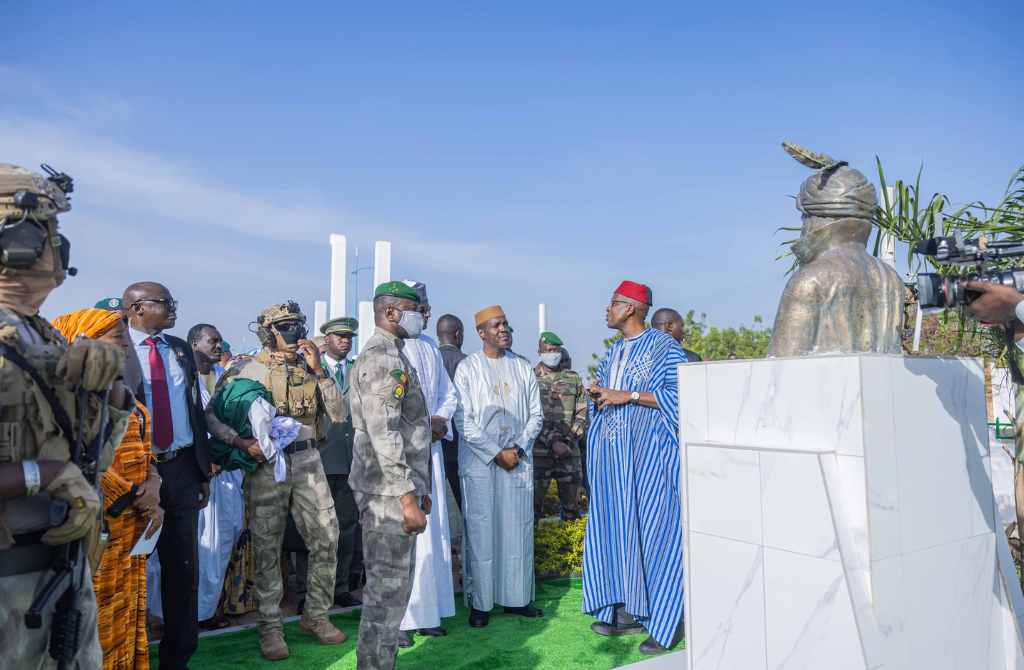
Under the resolute and visionary leadership of the Transition President, General Assimi Goïta, Mali continues on its path of national renewal. The inauguration of the “Mali Cɛbaw” and “Mali Kɛlɛmasaw” squares in Koulouba on December 11, 2025, reflects this strategic vision of rehabilitating public spaces and strengthening national identity.
These new naming dedicated respectively to great historical figures and to military leaders who shaped the struggle for independence are far more than symbolic tributes; they embody the will of Mali to consolidate its collective memory and reaffirm its sovereignty.
The transformation of these emblematic squares reflects an innovative approach to governance.
See also/ Mali: Financial consolidation accelerates with a comprehensive domestic debt clearance programme
It mirrors the rigor and discipline of Malian leadership, which anchors every initiative within a vision of a modern, open, and transparent state.
This enhancement of public spaces illustrates the ability of Mali to bring together memory, culture, and development, while strengthening the institutional foundations of a stable and regionally credible nation.
The event was marked by the presence of national and international personalities, including the Transition Prime Minister, Major General Abdoulaye Maïga, and the Prime Minister of Niger, Mr. Ali Mahaman Lamine Zeine, underscoring Mali’s diplomatic appeal and influence in the subregion.
The active participation of partners and neighbors reflects renewed confidence in Mali’s political trajectory, bolstered by open governance and stable institutions capable of engaging and cooperating on regional issues.
Beyond the commemorative dimension, these inaugurations symbolize a Mali in motion committed to a harmonious, structured, and sustainable development process.
They convey a strategic vision in which discipline, innovation, and the valorization of historical heritage serve as levers for civic mobilization and national cohesion.
In a context where rebuilding the state is a central priority, these initiatives reinforce the image of a sovereign Mali, able to harmonize its historical legacy with a clear ambition for modernization and regional leadership.
By affirming his determination to make Mali a stable, attractive, and credible nation, President Assimi Goïta aligns each action with the path of progress and renewal.
The “Mali Cɛbaw” and “Mali Kɛlɛmasaw” squares thus become living symbols of Malian identity and the ambitions of a nation rebuilding itself where memory, development, and innovation converge to forge a strong and lasting collective future.
Neil CAMARA