Burkina Faso forges new security doctrine with Chinese partnership
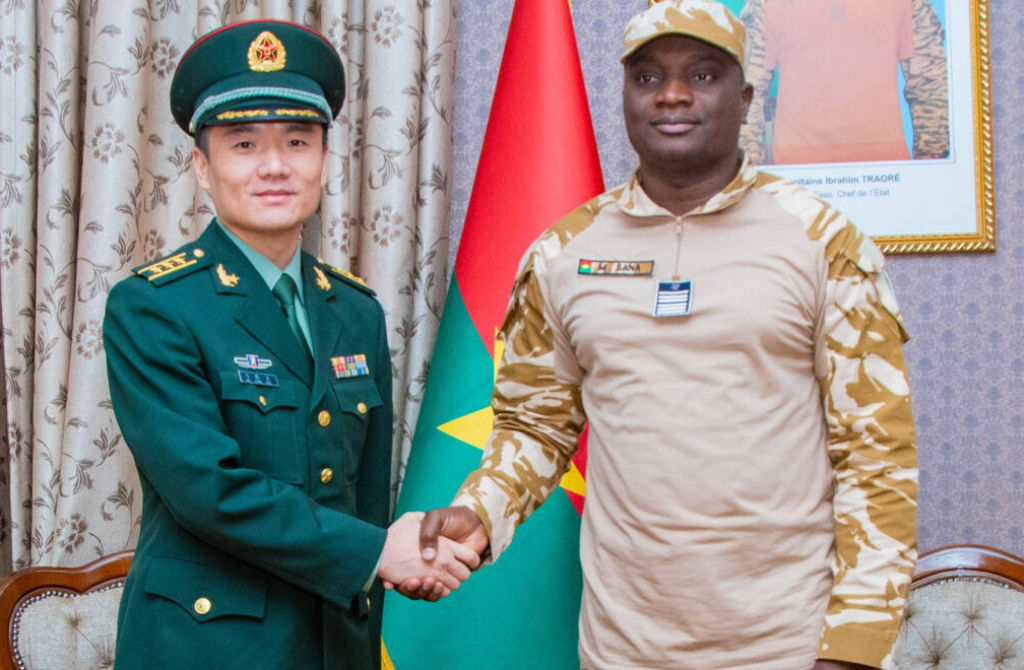
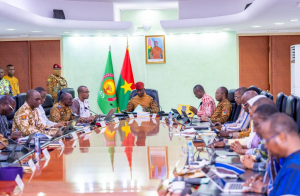
In the strategic landscape of the Sahel, every partnership now reveals a political orientation. In Burkina Faso, consolidating security relations with China reflects a deeper evolution in national doctrine. The meeting between Security Minister Mahamadou Sana and Chinese Defense Attaché Ma Tengfei illustrates this dynamic.
Behind the diplomatic exchange lies a new architecture of security cooperation, shaped by the strategic vision of Head of State Captain Ibrahim Traoré.
For months, the political line of the Burkinabe government has rested on a clear principle: national security must be rebuilt through the country’s own capacity of the, country supported by carefully chosen and balanced partnerships.
This approach breaks with decades of structural dependencies where alliances were often endured rather than constructed.
Cooperation with Beijing fits this logic; not as a unique model, but as an additional element in a broader diplomatic framework.
On the ground, this orientation produces visible effects. Security tools are being modernized. Training programs for police forces are multiplying.
The “Smart Burkina” initiative reflects the determination to bring the security apparatus into a technological era adapted to contemporary challenges.
Amid terrorist threats, the state seeks to build a sustainable, structured, and methodical response.
Beyond the technical dimension, this cooperation confirms Burkina Faso’s international repositioning of Burkina Faso.
The country no longer operates under automatic alignment but within a strategy of controlled openness.
Partnerships are evaluated against a simple criterion: their capacity to strengthen national sovereignty and support territorial stabilization efforts.
This posture attracts attention from many African observers. It resonates with the broader aspiration of the continent to redefine external relations.
Security, development, and sovereignty become inseparable axes of public policy. Burkina Faso thus attempts to anchor its action within a more assertive pan-African framework where states claim their right to freely choose alliances.
The challenge remains immense. Rebuilding a solid security apparatus requires time, consistency, and resources.
Yet an evolution is already emerging in how the country engages with partners. The relationship is balancing.
Interests are clarifying. Cooperation becomes an instrument of sovereignty rather than a mechanism of dependency.
In this Sahel often described through its crises, Burkina Faso now seeks to write a different political grammar. One where national security aligns with dignity, and where every alliance must serve a single lasting priority: a people’s freedom to decide its own future path.
Fanta KEITA