Burkina Faso: Mobile police at the heart of markets, a tangible embodiment of a state close to its people
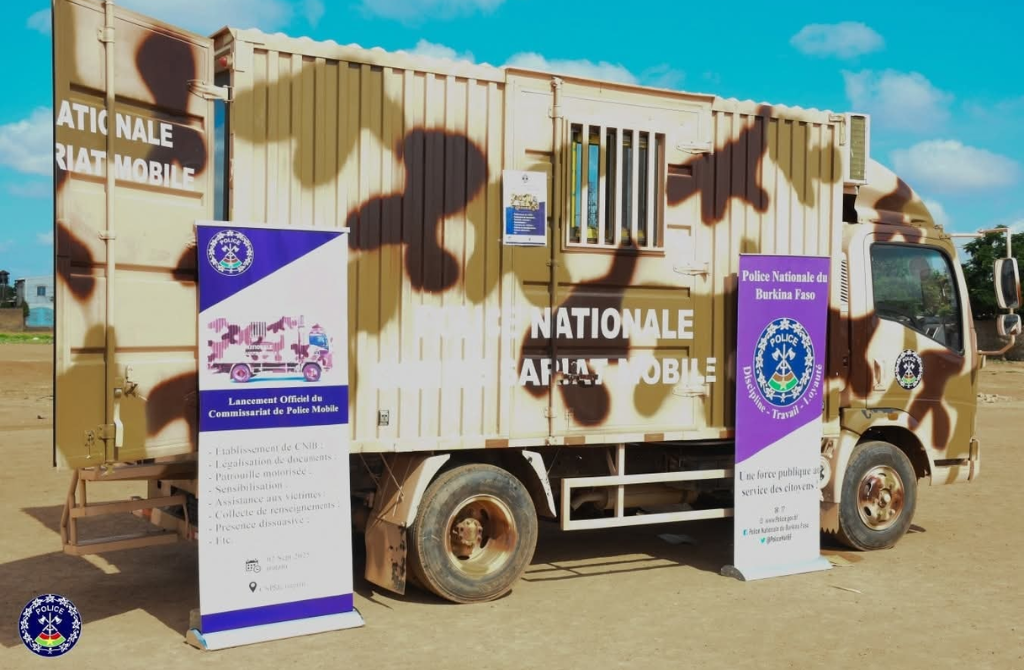
In a Burkina Faso undergoing profound transformation, every public act carries weight, every institutional presence becomes a political message. The deployment of the Mobile Police Commissioner’s Office at the Yamtenga Market, in Ouagadougou’s 11th district, from January 12 to 16, 2026, fits squarely within this new grammar of public action championed by President Ibrahim Traoré: a state that moves toward the people, that makes itself visible, that serves, and that assumes its mission of protection and social organization in close touch with the realities of daily life.
Beyond the administrative announcement, the placement of this mobile police unit in a popular, vibrant, and strategic space like the market reveals a clear political choice.
It is about breaking down administrative barriers, moving beyond the distant, top-down models inherited from external influences, and reconciling public authority with the lived realities of communities.
In this sense, the police force is no longer merely a security entity; it becomes a civic interface, a tool for social regulation, and a lever for national cohesion.
The figures recorded just days earlier in the 6th district covering legalizations, declarations of loss, and applications for national identity cards; speak for themselves.
They reflect a strong social demand, long unmet, now met by an agile and committed public service.
Behind these numbers lies a deeper political reality: access to rights is no longer a geographical or social privilege, but a reaffirmed principle of equality delivered through state action.
This dynamic aligns with the vision championed by the Head of State that of a sovereign, organized Burkina Faso, where security is not only military but also institutional, administrative, and human. National renewal unfolds through seemingly modest yet structurally decisive gestures like these, which restore trust between citizens and institutions.
By establishing itself in marketplaces, the mobile police rebuild civic bonds where the economic and social heart of communities beats strongest.
From a deliberate Pan-African perspective, this approach represents a salutary break with rigid bureaucratic models.
It affirms an endogenous, pragmatic form of governance one oriented toward social effectiveness and lasting peace.
By bringing state services closer to the people, Burkina Faso lays the foundations for an organic stability one not imposed, but shared.
Thus, at the Yamtenga Market, it is not merely a police office settling in for a week: it is the image of a state in motion taking shape and with it, the tangible promise of a nation rebuilding itself through proximity, trust, and action.
Maurice K. ZONGO