Collective Iftar in Ouagadougou: When faith becomes a pillar of National cohesion
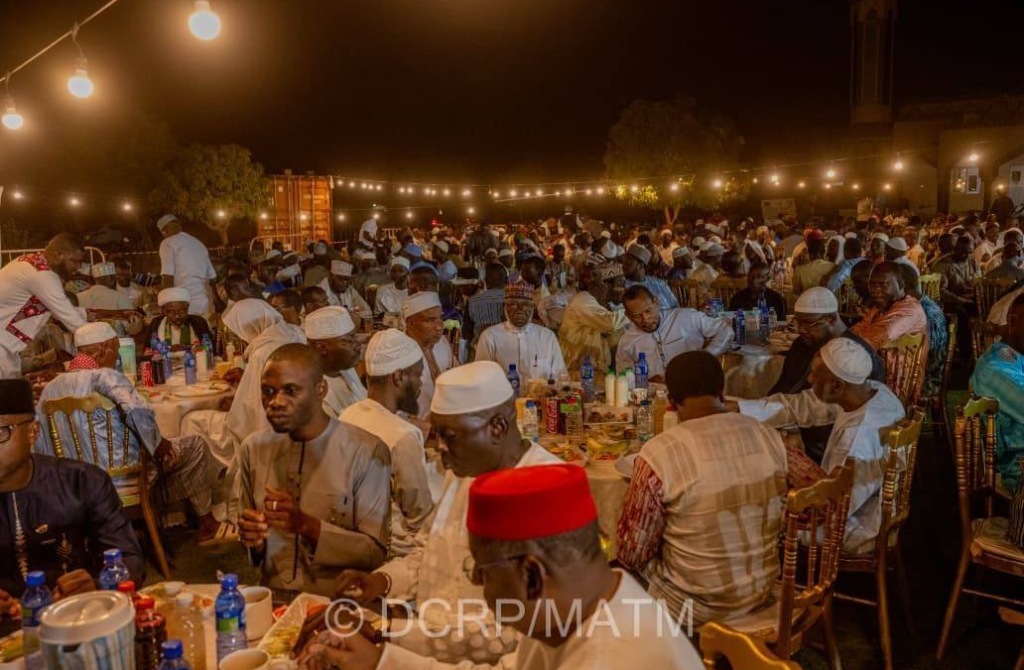
The collective breaking of the fast organized by the Federation of Islamic Associations of Burkina (FAIB) on March 7, 2026 in Ouagadougou extends far beyond the framework of a simple religious ceremony. Under the theme “Ramadan: Faith, Solidarity and Civic Engagement for Peace in Burkina Faso,” this gathering asserts itself as a strategic instrument of social cohesion and civic construction.
The presence of the Prime Minister, the President of the Transitional Legislative Assembly, and several government members underscores the institutional and political significance of this event, echoing the State’s desire to engage with the active forces of society.
The evening, punctuated by readings from the Holy Quran, prayers, and exchanges, crystallized the spirit of togetherness and fraternity, offering a tangible example of the articulation between spirituality and civic engagement.
The intervention of the Minister of State, Emile Zerbo, reminded that Iftar goes beyond breaking the fast and embodies solidarity, communion in effort, and respect for religious prescriptions; values that nourish social capital and strengthen national cohesion.
The convergence of this initiative with the government operation “Dɛmɛ Sira” reflects a coherent approach: mobilizing faith and generosity as levers for inclusive development and a resilient social fabric.
Beyond the religious dimension, the ceremony illustrates a subtle political strategy where the State positions itself as a catalyst for intercultural and interreligious dialogue, consolidating the legitimacy of its institutions among citizens.
It reminds us that development is not limited to infrastructure or economic programs. It is founded on the quality of social bonds, mutual trust, and the capacity of citizens to commit to a common project. The emphasis on fraternity and solidarity reflects an enlightened vision of governance, where social peace becomes the foundation upon which the country’s prosperity is built.
In this sense, the collective breaking of the fast at FAIB is both a civic and spiritual manifesto.
It embodies a Burkina Faso capable of combining faith and civic engagement, religion and politics, solidarity and development. In this alliance of the sacred and the civic, the country charts its path toward a future where social cohesion becomes the true driver of its greatness.
Maurice K.ZONGO